Overview
The China national football team (commonly called China PR) represents the People’s Republic of China in international men’s football and is governed by the Chinese Football Association (CFA). Established in the early 20th century, the team has experienced periods of regional strength, a long quest to qualify for the FIFA World Cup, and recent efforts to raise standards through investment, professionalization and foreign coaching influence.
- Confederation: Asian Football Confederation (AFC)
- Nickname(s): Team Dragon, 中国国家队 (Zhongguo Guoji Dui)
- Home stadiums: Various (Bird’s Nest/Beijing National Stadium used on high-profile occasions; other matches held at major domestic stadiums)
History — summary timeline
- Early years (1920s–1949): China played its first internationals in the 1920s and competed in early Far Eastern Championship Games. The pre-1949 team participated in regional competitions but international activity was limited.
- People’s Republic era beginnings (1950s–1970s): After 1949, China’s international involvement was intermittent because of political factors. The team took part in Asian competitions and Olympic qualifiers when possible.
- Rise in Asia (1970s–1990s): From the late 1970s onward China became a competitive Asian side. The team won its first major continental trophy — the Asian Games gold medal in 1984 — and regularly challenged in AFC Asian Cup tournaments and World Cup qualifying.
- Professional era and peak (1994–2002): Domestic professionalization with the launch of a national professional league (Jia-A League, later the Chinese Super League) improved standards. China’s greatest achievement arrived with qualification to the 2002 FIFA World Cup, the team’s only World Cup finals appearance to date.
- Post-2002 period (2003–present): After 2002 China has frequently reached later stages of AFC Asian Cup and advanced in World Cup qualifying but failed to qualify again. The CFA undertook major investment in youth development, foreign coaches and high-profile player acquisitions in the domestic league to raise the national team’s level, with mixed results.
Major successes
- 2002 FIFA World Cup qualification — China’s landmark achievement, qualifying for the World Cup for the first and only time in 2002 (co-hosted by Japan and South Korea). China was eliminated in the group stage without scoring a goal, but qualification remains the high-water mark in modern history.
- Asian Games — Gold medal in 1984 (football at the Asian Games is a significant regional achievement).
- AFC Asian Cup — China has not won the Asian Cup but has been runner-up once (1984) and finished in the top four on multiple occasions, including fourth place in 2004 when China hosted the tournament and reached the semifinals.
- East Asian competitions — Solid performances in regional East Asian tournaments and friendlies, demonstrating competitive regional standing when at full strength.
Most notable players
- Li Weifeng — A commanding center back and long-time captain who featured across the 1990s and 2000s; known for leadership and aerial ability, he played abroad briefly and was a mainstay of the national side during World Cup qualifying.
- Sun Jihai — One of China’s most successful exports to Europe; fullback/winger who played for Manchester City (2002–2008) and was the first East Asian to appear regularly in the English Premier League. Important for modernizing the perception of Chinese players abroad.
- Fan Zhiyi — Versatile defender/midfielder who captained China and played in Europe (including Crystal Palace and Dundee). Winner of the Chinese Footballer of the Year; influential in the 1990s renaissance of Chinese football.
- Yang Chen — Forward who played in Germany (Eintracht Frankfurt) and scored for club and country; among the first Chinese players to make an impact in top European leagues.
- Zheng Zhi — Midfielder and captain for many years; moved abroad (Shenzhen → Charlton on loan → Celtic → Charlton permanently → Shandong/Guangzhou) and later played a key role at Guangzhou Evergrande. Known for leadership, technical ability and longevity.
- Hao Haidong — One of China’s most prolific strikers and a significant goalscorer in domestic and continental competition during the 1990s and early 2000s.
- Wu Lei — A more recent star, prolific forward who moved to RCD Espanyol in La Liga and became a symbol of modern Chinese exports; solid national-team striker and public figure for Chinese football’s ambitions.
Notable coaches
- Bora Milutinović (Serbia/Yugoslavia) — Legendary World Cup specialist coach brought in to guide China through qualifying and was the head coach who led China to qualification for the 2002 World Cup. Known for getting the best out of diverse teams in qualification campaigns.
- Arie Haan (Netherlands) — Dutch coach who led China in the late 1990s and helped modernize tactics and preparation during a formative era.
- Marcello Lippi (Italy) — World Cup–winning coach with Italy (2006) who had a high-profile stint as China’s head coach (2016–2019). Hired with the ambition of overhauling the national program and introducing elite-level standards; results were inconsistent, but his tenure reflected China’s aim to import top coaching expertise.
- Alain Perrin (France) — Coached China in the lead-up to the 2011 AFC Asian Cup; a respected European coach with international experience.
- Former domestic figures — Several influential Chinese coaches (e.g., Gao Hongbo) have led the national team at different times; Gao, in particular, is credited with popular, attacking football during his spells and building youth structures.
Recent developments and direction
In the 2010s and 2020s the Chinese FA and government supported major investment in the domestic league, youth academies, infrastructure and the recruitment of foreign coaches and players to raise standards. The aim has been to produce a second World Cup qualification, improve performance at the AFC Asian Cup, and develop homegrown talent to compete at higher international levels. Results have been mixed: the domestic league attracted attention and big-name signings, but producing consistent international success has proven difficult and remains an ongoing project.
Legacy
China’s national team occupies a prominent place in Asian football history: a large footballing nation with one World Cup appearance, a continental medal history and several players who helped break ground for Chinese exports to Europe. The team continues to be a major focus for national investment and ambition in the sport, aiming to translate domestic resources into sustained international success.
| # | Name | Nat. | Position | Value |
|---|---|---|---|---|
| 1 |
 FU YUBIN FU YUBIN
|
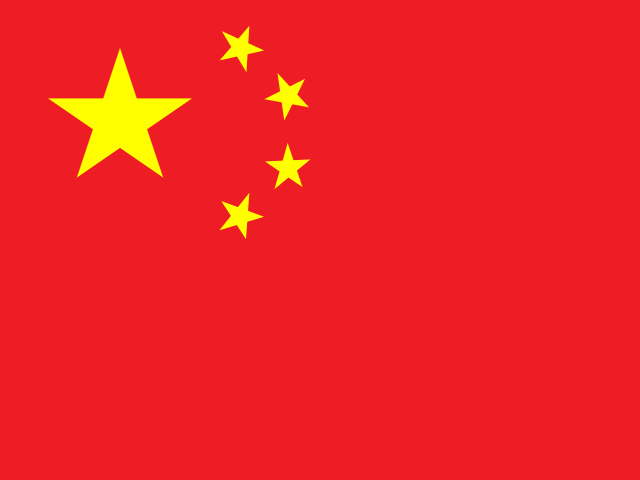 CHN
CHN
|
G | £250k |
| 2 |
FENG ZHIGANG
|
CHN
|
RB | £200k |
| 3 |
DONG LIQIANG
|
CHN
|
LB | £200k |
| 4 |
FAN ZHYI
|
CHN
|
D | £180k |
| 5 |
XU HONG
|
CHN
|
D | £200k |
| 6 |
LI BING
|
CHN
|
RW | £200k |
| 7 |
WU QUNLI
|
CHN
|
LW | £180k |
| 9 |
HAO HAIDONG
|
CHN
|
A | £160k |
| 10 |
GAO HONGBO
|
CHN
|
M | £160k |
| 10 |
CAI SHENG
|
CHN
|
M | £300k |
| 11 |
PENG WEIGUO
|
CHN
|
A | £200k |
| 12 |
OU CHULIANG
|
CHN
|
G | £110k |
| 13 |
LI MING
|
CHN
|
D | £150k |
| 14 |
GAO ZHONGXUN
|
CHN
|
M | £130k |
| 15 |
ZHAO LIN
|
CHN
|
M | £100k |
| 16 |
LI XIAO
|
CHN
|
A | £150k |
ZHYI
HONG
LIQIANG
HONGBO
SHENG
QUNLI
WEIGUO