Overview
The Ethiopia national football team, nicknamed the "Walia Ibex" (after a wild mountain goat native to Ethiopia) and also historically called the "Red Lions," is the national side representing Ethiopia in international men's association football. It is governed by the Ethiopian Football Federation (EFF), a member of the Confederation of African Football (CAF) and the Fédération Internationale de Football Association (FIFA).
History
- Early years and regional roots (1940s–1950s): Football was introduced to Ethiopia in the early 20th century and grew during the 1920s–1940s. The national team played its first significant international fixtures in the 1940s and 1950s, mostly against neighboring countries. Ethiopia was one of the early members of CAF.
- Era of continental prominence (1950s–1960s): Ethiopia was a founding member of the African Cup of Nations. The team’s most notable early achievement came in 1962 when Ethiopia hosted and won the Africa Cup of Nations (AFCON). That tournament remains the nation's only continental title to date. The squad combined local talent with an organized approach under strong domestic support, and the victory is a landmark in Ethiopian sporting history.
- Decline and struggles (1970s–1990s): After the 1960s, political upheaval, economic difficulties, and challenges in football administration contributed to a decline in international competitiveness. Ethiopia struggled to qualify for AFCON and other major tournaments for decades, with inconsistent results at regional and continental levels.
- Rebuilding and modern era (2000s–present): In the 2000s and 2010s the EFF undertook efforts to rebuild, including youth development and improved domestic competitions. Ethiopia qualified for AFCON 2013, their first appearance in over three decades, and again for AFCON 2021 (played in 2022). These qualifications signaled a partial resurgence and renewed national interest in the team.
Major successes
- Africa Cup of Nations champions, 1962: Ethiopia hosted and won the tournament, beating the United Arab Republic (Egypt) in the final round-robin stage. This remains Ethiopia’s greatest achievement in international football.
- AFCON appearances: Ethiopia were regular participants in the early editions of the AFCON (1957–1970s) and have made several later qualifications, including 2013 and 2021 (tournament held in 2022).
- Regional competitions: Ethiopia has had periodic success in CECAFA (Council for East and Central Africa Football Associations) competition, with several strong performances and tournament wins historically at regional level, reflecting its influence in East African football.
Notable players
- Mengistu Worku — Widely regarded as Ethiopia’s finest-ever player and one of Africa’s greats of his generation. A forward active in the 1950s–1960s, Mengistu was a key figure in the 1962 AFCON victory and remembered for his skill, scoring ability and influence on the team.
- Tesfaye Gebreyesus (often listed as Tesfaye "Tessema") — An important player from the same era, contributing to Ethiopia’s early continental competitiveness.
- Yohannes "Yohannes" (various historic names) — Several prominent domestic-era stars contributed to Ethiopia’s strength in the 1950s–60s; records from that period often list multiple influential attackers and defenders who formed the core of the title-winning side.
- Salem Reja — Later-generation player who helped raise the profile of the national side during intermittent resurgence phases.
- Modern-era players (2010s–2020s): Players like Getaneh Kebede (striker), Saladin Said, and other domestic and foreign-based Ethiopians have been key in recent qualifications and in reviving national hopes. Goalkeeper and defensive standouts in recent squads also played important roles during AFCON qualifications and tournaments.
- Note: Ethiopian football history includes many influential domestic stars whose records are strongest in local and regional memory; archival gaps and differing transliterations mean some historic names appear in variant forms.
Notable coaches
- Yidnekatchew Tessema — More famous as a football administrator and CAF pioneer, Tessema had a major influence on Ethiopian football and African football governance. His leadership helped shape early football development in the country and continent.
- Arab/foreign coaches in modern era — Ethiopia has employed a number of foreign coaches in attempts to modernize tactics and raise standards. Coaches such as Sewnet Bishaw (Ethiopian, but prominent as head coach), who guided Ethiopia to the 2013 AFCON qualification, are notable for recent successes.
- Sewnet Bishaw — Credited with leading Ethiopia back to the Africa Cup of Nations in 2013 after a long absence; he is one of the more prominent modern-era coaches for the national team.
- Other foreign coaches — Over different periods Ethiopia brought in coaches from Europe, Africa, and Asia to provide expertise. Their impact varied, but these appointments reflect ongoing efforts to professionalize coaching and match preparation.
Legacy and current status
Ethiopia is one of African football’s historic nations: an early AFCON champion and a founding presence in continental football structures. While the team experienced long periods of decline, intermittent revivals — including AFCON qualifications in the 2010s and 2020s — show continued potential. Domestic league development, youth programs, and diaspora players remain key to Ethiopia’s hopes for greater consistency and future success on the African stage.
Sources and records
Historical records, especially from the 1950s–1970s, sometimes vary in name spellings and statistics. Most authoritative information is held by the Ethiopian Football Federation, CAF and FIFA archives, and contemporary match reports and histories of the Africa Cup of Nations.
| # | Name | Nat. | Position | Value |
|---|---|---|---|---|
| 1 |
 DESALEGN DESALEGN
|
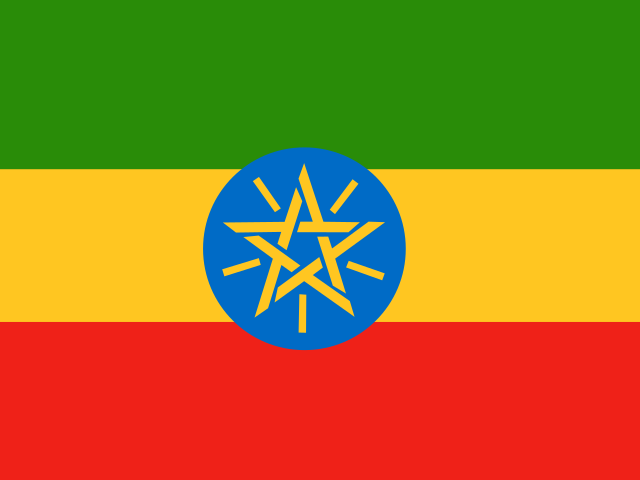 ETH
ETH
|
G | £130k |
| 2 |
MENGISTU
|
ETH
|
RB | £150k |
| 3 |
TESFAYE
|
ETH
|
LB | £150k |
| 4 |
MULAT
|
ETH
|
D | £130k |
| 5 |
GETACHEW
|
ETH
|
D | £150k |
| 6 |
KISLU
|
ETH
|
RW | £160k |
| 7 |
LEGESSE
|
ETH
|
LW | £160k |
| 8 |
KEBEDE
|
ETH
|
M | £150k |
| 9 |
BEGUASHAW
|
ETH
|
A | £130k |
| 10 |
TENKER
|
ETH
|
M | £130k |
| 11 |
HAILE
|
ETH
|
A | £130k |
| 12 |
BELETE
|
ETH
|
G | £75k |
| 13 |
DANIEL
|
ETH
|
D | £85k |
| 14 |
GENEN
|
ETH
|
M | £85k |
| 15 |
GOLLA
|
ETH
|
M | £100k |
| 16 |
ASEFA
|
ETH
|
A | £100k |
MULAT
GETACHEW
TESFAYE
KEBEDE
TENKER
LEGESSE
HAILE