Mali national football team — overview
The Mali national football team (Les Aigles — The Eagles) is the senior association football team that represents Mali in international competition. Controlled by the Malian Football Federation (Fédération Malienne de Football, Femafoot), Mali has been an established presence in African football since independence, known for producing technically gifted, pacey players and for competitive showings at African Cup of Nations (AFCON) tournaments and youth world events.
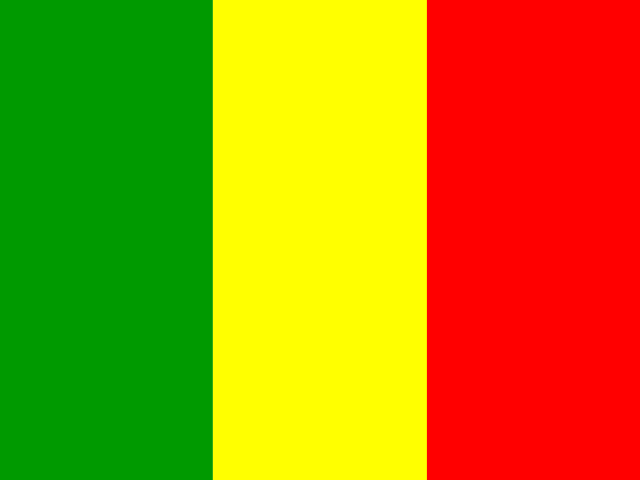
- FIFA affiliation and colors: Mali has been affiliated to FIFA and the Confederation of African Football (CAF) since the 1960s; the team traditionally plays in green, yellow and red—colors of the national flag.
History and development
- Early decades (1960s–1980s): Mali’s national team formed in the post‑independence period. They made early impression by finishing runners‑up at the 1972 African Cup of Nations (AFCON), which remains their best finish at senior continental level. Otherwise, the team often struggled with inconsistent results, limited resources and political instability at home that impacted football infrastructure and development.
- 1990s–2000s rebuilding: Investment in youth development and the rise of Malian players based in Europe gradually improved competitiveness. Mali qualified for AFCON intermittently and became more visible on the youth stage, which helped build a stronger senior pool.
- 2010s — era of competitiveness: Mali became a regular AFCON participant, generally advancing from group stages and reaching knockout rounds several times (quarterfinals and semifinals). The national side benefited from a generation of players starring in major European leagues and a professionalized domestic setup.
- Youth success and pipeline: Mali’s youth teams have been particularly successful — notably finishing third at the FIFA U-20 World Cup in 1999 and runners‑up at the U-20 AFCON and other age‑group tournaments — establishing the country as a strong talent producer in Africa.
Major successes and notable results
- 1972 African Cup of Nations: Mali finished second, losing to Congo in the final. This remains the country’s best senior continental finish.
- Consistent AFCON showings: In recent decades Mali has repeatedly qualified for AFCON and reached latter stages multiple times (round of 16, quarterfinals, semifinals), showing the team is regularly competitive at continental level.
- Youth tournament achievements: Mali’s U‑20 and U‑17 sides have had strong performances. Highlights include a third place at the 1999 FIFA U‑20 World Cup and a runners‑up finish at the 2015 FIFA U‑20 World Cup, plus several strong runs at African youth championships. These successes have supplied talent to the senior team.
- Individual match highlights: Mali has earned notable friendly and competitive victories over higher‑ranked African nations and has produced memorable performances in qualification campaigns and tournament knockout matches.
Most notable players
- Seydou Keïta: Midfielder renowned for vision, passing and timing. Keïta had a stellar club career in Europe (notably with Sevilla, Lens and Barcelona) and was central to Mali’s midfield for many years.
- Frédéric Kanouté: Born in France and eligible for Mali, Kanouté was a prolific forward (successful at Sevilla and West Ham early in his career) who chose to represent Mali internationally and became a talismanic scorer for the national side.
- Mahamadou Diarra: Defensive midfielder with a commanding presence; he starred at clubs such as Lyon and Real Madrid and anchored Mali’s midfield during his international years.
- Modibo Maïga: Forward who enjoyed a long international career and club spells in Europe and Asia; contributed goals and physical presence up front.
- Salif Keïta (veteran era): An earlier generation star (not to be confused with Seydou Keïta) — Salif was one of Mali’s most prominent pre‑1970s players and later influential as an administrator and mentor in Malian football.
- Yves Bissouma (recent generation): Midfielder who emerged in European club football (notably Brighton & Hove Albion and later Tottenham) and provided energy, ball‑winning and progressiveness for Mali in the late 2010s and 2020s.
- Moussa Marega and Adama Traoré (other contributors): Several players with similar names and overlapping West African origins have represented Mali or Malian heritage; depending on era, players like Moussa Marega and others have been key for attack and reach.
Notable coaches and technical figures
- Stéphane Demol / Alain Giresse era influences: Mali has been coached by a mixture of respected African, European and local coaches. Alain Giresse (a celebrated French midfielder who coached Mali) had a significant impact, guiding the team during competitive AFCON campaigns and helping tactical and technical development.
- Local and continental coaches: Mali has relied at different times on experienced African coaches and Malian managers to stabilize and exploit local talent. Coaching changes have been common but several appointments focused on integrating the strong youth pipeline into the senior side.
- Technical directors and youth coaches: Given Mali’s notable youth success, the role of youth coaches and technical directors has been crucial in scouting, developing and transitioning young talents into the senior national team.\
Style and identity
Mali traditionally plays an attacking and technically adept brand of football that emphasizes ball control, quick passing and athletic wingers. Many Malian players are comfortable on the ball and able to play in European systems, which has helped the national team adopt flexible tactical shapes under different coaches.
Challenges and outlook
- Mali faces challenges common to many African federations: periodic political instability, funding and infrastructure shortfalls, and the logistical difficulty of assembling Europe-based players. Despite these, the continued emergence of talented youth prospects and regular AFCON participation give the team a solid foundation for future success.
- With a growing number of Malians in top leagues and an established youth production system, the outlook is that Mali will remain a regular contender at AFCON and a supplier of talented players to international clubs.
Summary
Mali’s national team is a respected force in African football with a proud history highlighted by the 1972 AFCON runners‑up finish and strong youth tournament records. The nation has produced outstanding players (Seydou Keïta, Frédéric Kanouté, Mahamadou Diarra among them) and a stream of promising young talent. Continued investment in development and stability in coaching should keep Mali competitive on the continental stage.
| # | Name | Nat. | Position | Value |
|---|---|---|---|---|
| 1 |
 DIARRA SOW DIARRA SOW
|
 MLI
MLI
|
G | £250k |
| 2 |
DEMBELE
|
MLI
|
RB | £200k |
| 3 |
KOUREISSI
|
MLI
|
LB | £200k |
| 4 |
MAMADOU KEITA
|
MLI
|
D | £300k |
| 5 |
MAMADOU COULIBALY
|
MLI
|
D | £250k |
| 6 |
MAKAN KEITA
|
MLI
|
RW | £500k |
| 7 |
HADY DIALLO
|
MLI
|
LW | £350k |
| 8 |
DJAKARIDIA DIARRA
|
MLI
|
M | £250k |
| 9 |
ABDOULKARIM MAGASSOUBA
|
MLI
|
A | £350k |
| 10 |
BOUBACAN BARRY
|
MLI
|
M | £300k |
| 11 |
MODIBO DEMBELE
|
MLI
|
A | £450k |
| 12 |
FAROTA
|
MLI
|
G | £150k |
| 13 |
YATOUMA DIOP
|
MLI
|
D | £180k |
| 14 |
MOUSSA SAMAKE
|
MLI
|
M | £200k |
| 15 |
TAMBOURA
|
MLI
|
M | £160k |
| 16 |
SEYDOU DIARRA
|
MLI
|
A | £180k |
KEITA
COULIBALY
KOUREISSI
DIARRA
BARRY
DIALLO
DEMBELE