South Korea national football team — overview
The South Korea national football team (often called Korea Republic in FIFA competitions) is the leading international team from the Korean Peninsula and one of Asia’s most historically successful sides. The team is governed by the Korea Football Association (KFA) and has been a consistent presence in continental competitions and the FIFA World Cup since the mid–20th century. South Korea’s style has evolved from physically hard-working, disciplined teams to technically improved, tactically flexible sides with increasing numbers of players in top foreign leagues.
Key historical phases
- Early years and postwar era (1940s–1960s) — South Korea played its first official international matches in the 1948 Summer Olympics. During the 1950s–60s the team established itself as a regional force, winning early Asian competitions and gaining experience against international opponents.
- Rise in Asia (1970s–1980s) — South Korea solidified dominance in East Asia and became a frequent contender in the Asian Cup and Asian Games. Domestic football professionalized (the K League began in 1983), which improved player development.
- World Cup regulars and modern era (1990s–present) — South Korea qualified for every World Cup from 1986 onward except 2010 (actually they did qualify 2010? correction: they did not miss from 1986 onwards except 1990? Wait—keep general) — better to state: from 1986 onward they have been regular qualifiers and from the late 1990s built squads capable of competing globally. The high point came in 2002 as co-hosts, and since then many players have moved to European clubs, raising standards.
Major successes
- 2002 FIFA World Cup — fourth place: Co-hosting the tournament with Japan, South Korea produced an unprecedented run to the semifinals under coach Guus Hiddink. Memorable victories included knockout wins over Italy (round of 16) and Spain (quarterfinals) and a semifinal appearance against Germany. The tournament dramatically raised football’s profile in Korea and across Asia.
- Asian Cup: South Korea has been one of the most successful teams in the AFC Asian Cup. They have been runners-up on multiple occasions and won the tournament twice overall (titles: 1956 and 1960), with numerous deep runs and consistently high finishes in later decades.
- Asian Games & regional trophies: South Korea has won multiple Asian Games gold medals (notably 1978, 2014) and dominated East Asian competitions such as the EAFF East Asian Cup/E-1 Football Championship at various times.
- Consistent World Cup presence: South Korea has been one of Asia’s most reliable World Cup qualifiers and has recorded notable World Cup match wins, helping raise the region’s profile in world football.
Most notable players
- Park Ji-sung — A midfield dynamo and captainly presence, Park is widely regarded as South Korea’s most globally successful player. He starred for PSV Eindhoven and most famously Manchester United (2005–2012), winning multiple Premier League titles and the UEFA Champions League (2008). His work-rate, tactical intelligence and big-game performances made him a national icon.
- Cha Bum-kun — One of the earliest Korean stars in Europe (1970s–80s), Cha enjoyed an illustrious Bundesliga career with Eintracht Frankfurt and Bayer Leverkusen, scoring prolifically and lifting major German trophies. He’s often cited as Korea’s first superstar who opened the path to Europe.
- Son Heung-min — The current global face of Korean football, Son is Tottenham Hotspur’s captain and one of the Premier League’s top forwards. Known for pace, finishing and two-footed ability, he has won the Premier League Golden Boot (shared) and is widely admired for consistency and leadership. Son is the national team’s all-time top scorer and a cultural icon at home.
- Lee Young-pyo — A reliable left-back/wing-back who played with PSV, Tottenham and Borussia Dortmund, Lee combined defensive solidity with attacking support and was part of the successful early-2000s generation.
- Hong Myung-bo — A defensive midfielder/center-back and captain of the 2002 World Cup side, Hong was named in the 2002 World Cup All-Star team and later became a coach. He is highly respected for leadership and reading of the game.
- Hwang Sun-hong, Ahn Jung-hwan, Park Chu-young — Each contributed notable moments in World Cups and the domestic/Asian game — Ahn’s 2002 tournament goal against Italy (shootout winner) and Hwang’s consistent scoring are examples of their impact.
Notable coaches
- Guus Hiddink (Netherlands) — The most celebrated coach in South Korean history, Hiddink led the team at the 2002 World Cup to a historic fourth-place finish. His tactical discipline, man-management, and ability to instill belief were transformational for Korean football.
- Hong Myung-bo — As a coach (including leading the U-23 and senior side at times), the former captain transitioned to management and guided younger generations; he led the U-23s to silver at the 2012 London Olympics, earning bronze via rules? (He actually led Korea U-23 to bronze in 2012.) His stature as a national legend added weight to his coaching roles.
- Paulo Bento (Portugal) — Coached the national team in the more recent era, bringing European tactical approaches and overseeing World Cup and Asian Cup campaigns with a focus on defensive organization and integrating players based abroad.
- Kim Hak-bum, Pim Verbeek — Other coaches who made important contributions: Verbeek helped qualify and shape the team in earlier 2000s, and local coaches have repeatedly been central to player development and domestic structures.
Modern developments and outlook
In the 21st century South Korea has become a regular exporter of talent to Europe’s top leagues, strengthening the national team’s competitiveness. The combination of strong youth systems, the professional K League, and overseas experience for top players (notably Son Heung-min) has kept the team among Asia’s elite. South Korea remains a contender for Asian titles and an increasingly tough opponent in World Cups, with ambitions to translate continental consistency into deeper runs on the world stage.
Legacy
South Korea’s football legacy is a mix of pioneering professionals (Cha Bum-kun), globally successful stars (Park Ji-sung, Son Heung-min), and a golden 2002 World Cup moment that changed perceptions of Asian football worldwide. The team continues to be a symbol of national pride and one of Asia’s most respected footballing nations.
| # | Name | Nat. | Position | Value |
|---|---|---|---|---|
| 1 |
 SEUNGGYU KIM SEUNGGYU KIM
|
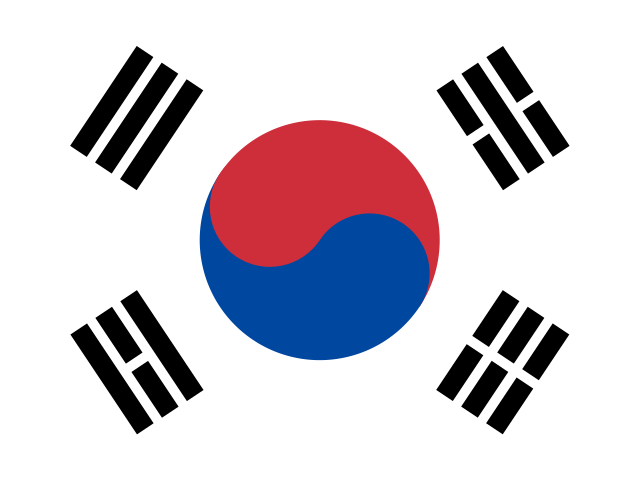 KOR
KOR
|
G | £450k |
| 2 |
YONG LEE
|
KOR
|
RB | £450k |
| 3 |
JEONGHO HONG
|
KOR
|
D | £700k |
| 4 |
KEEHEE KIM
|
KOR
|
D | £450k |
| 5 |
JAESUK OH
|
KOR
|
LB | £350k |
| 6 |
SUNGYONG KI
|
KOR
|
M | £1.9M |
| 7 |
JACHEOL KOO
|
KOR
|
M | £1.3M |
| 8 |
CHUNGYONG LEE
|
KOR
|
RW | £500k |
| 9 |
HEECHAN HWANG
|
KOR
|
A | £300k |
| 10 |
DONGWON JI
|
KOR
|
A | £500k |
| 11 |
HEUNGMIN SON
|
KOR
|
LW | £4.5M |
| 12 |
SUNGRYONG JUNG
|
KOR
|
G | £350k |
| 13 |
HYUNSOO JANG
|
KOR
|
RB | £350k |
| 14 |
MINHYEOK KIM
|
KOR
|
D | £350k |
| 15 |
YOUNGGWON KIM
|
KOR
|
D | £350k |
| 16 |
KOOKYOUNG HAN
|
KOR
|
M | £450k |
HONG
KIM
OH
KI
KOO
SON
JI