Argentina national soccer team — overview
The Argentina national football team (Selección Argentina) is one of the world’s most successful and historically significant national teams. Founded in the early 20th century, Argentina has long been a powerhouse in South America and on the global stage, known for producing world-class talent, a passionate football culture, and distinctive, technically gifted play.
- FIFA and confederation: Member of FIFA and CONMEBOL (South American Football Confederation).
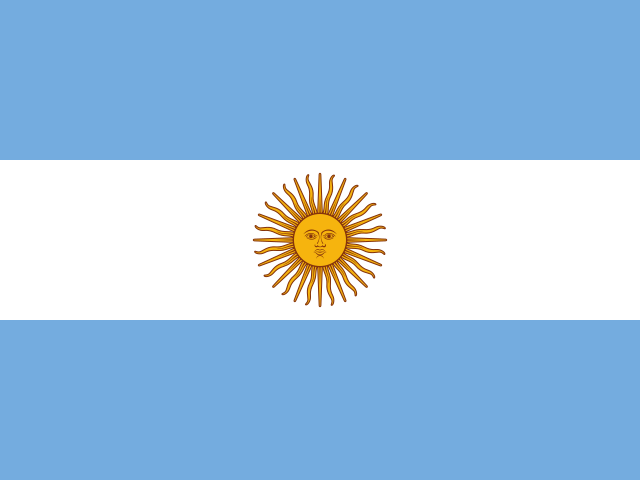
- Colors and nickname: Famous sky‑blue and white (celeste y blanca); nicknames include La Albiceleste and La Selección.
- Home stadiums: Historically played home matches at many venues across Argentina; iconic matches at Estadio Monumental (River Plate) in Buenos Aires.
History and development
- Early years (1900s–1930s): Argentina played its first official international in 1901. The team quickly became a regional force, competing in the earliest South American Championships (now Copa América). Argentina helped shape international football in South America and toured Europe in the 1920s, gaining recognition for technical skill and attacking football.
- Mid‑century (1940s–1960s): Domestic and international success was intermittent. Argentina won several South American titles but did not compete in some early World Cups for political and organizational reasons. The team’s style evolved with strong club-level influence (River Plate, Boca Juniors, Independiente, Racing, San Lorenzo).
- Rise to global prominence (1970s–1980s): Argentina won its first major global title at the 1978 FIFA World Cup at home, coached by César Luis Menotti. This era produced legendary players and a national pride. In 1986 Argentina won the World Cup in Mexico under Diego Maradona, one of football’s defining triumphs—Maradona’s performances, including the “Hand of God” and the “Goal of the Century” against England, are iconic.
- Late 20th century to early 2000s: Argentina remained a top contender but endured tournament disappointments (World Cup runner-up 1990, several Copa América near-misses). The national pool continued to supply elite talent to top European clubs.
- Recent era (2010s–2020s): Argentina reached the 2014 World Cup final (lost to Germany) and won the Copa América in 2021 (ending a 28‑year senior competitive trophy drought) and again in 2024. The team culminated this modern renaissance by winning the 2022 FIFA World Cup in Qatar under coach Lionel Scaloni, with Lionel Messi as captain—securing Argentina’s third World Cup and cementing a generational legacy.
Major successes
- FIFA World Cup: Champions in 1978 and 1986 and 2022; runners-up in 1930, 1990, and 2014.
- Copa América: Multiple-time champions (titles across different eras — notable wins include 1947, 1959, 1991, 1993, 2021, 2024). Argentina is among the most successful teams in the tournament’s history.
- Other trophies: Olympic gold medals in football (2004, 2008); CONMEBOL–UEFA Cup of Champions (Finalissima) winners (2022). Numerous youth-level world titles, reflecting strong development pathways.
Most notable players
- Diego Maradona: Often regarded as one of the greatest players ever; led Argentina to the 1986 World Cup title with transcendent individual performances. A cultural icon whose dribbling, vision, and charisma defined an era.
- Lionel Messi: Widely considered among the best players in history; prolific goalscorer and playmaker. Captain of the 2022 World Cup–winning team and central to Argentina’s Copa América 2021 triumph. Holder of numerous individual records and awards.
- Alfredo Di Stéfano: Although he played internationally in different contexts (Argentina, Colombia, Spain), Di Stéfano’s club and international influence mark him as an all‑time great connected to Argentine football’s heritage.
- Gabriel Batistuta: Prolific striker and Argentina’s top scorer for many years; renowned for powerful finishing and consistency in the 1990s and early 2000s.
- Juan Román Riquelme: Classic Argentine playmaker, celebrated for technique, vision, and set‑piece delivery—an emblem of creative midfield talent.
- Sergio Agüero, Hernán Crespo, Javier Zanetti, Daniel Passarella, Mario Kempes: Each left major marks—Agüero and Crespo as modern goal scorers, Zanetti as a model leader and fullback/captain, Passarella as a commanding defender and 1978 captain, and Kempes as 1978 World Cup Golden Boot winner and final’s star.
Notable coaches and their impact
- César Luis Menotti: Coach of the 1978 World Cup–winning side; advocated attack-minded, artistic football and helped professionalize and modernize coaching in Argentina.
- Carlos Bilardo: Architect of the 1986 World Cup squad (as coach) and manager of the 1990 runners‑up; emphasized tactical discipline and balance, complementing Maradona’s genius.
- Diego Maradona (as coach): Managed Argentina at the 2010 World Cup; his tenure was high-profile though not highly successful competitively.
- Sergio Batista and Alejandro Sabella: Batista led the team to Olympic gold (2008) and Sabella guided Argentina to the 2014 World Cup final with a tactically solid side centered on Messi.
- Lionel Scaloni: Initially an interim appointment, Scaloni built a cohesive, modern squad blending experienced stars and young talent—winning Copa América 2021, the 2022 World Cup, and maintaining a strong team identity thereafter.
Style and cultural significance
- Argentina’s style blends technical skill, creativity, and a strong attacking tradition with a fierce competitive mentality. Historically celebrated for dribblers, playmakers, and intuitive forwards.
- Football is deeply woven into Argentine national identity; successes and failures of La Albiceleste resonate broadly across society and culture, producing iconic moments that transcend sport.
Legacy
Argentina sits among the elite football nations: multiple World Cup titles, a rich Copa América pedigree, a continuous production line of top players, and a legacy shaped by figures such as Maradona and Messi. The team’s history is marked by passionate support, tactical evolution, and global influence on how the game is played and appreciated.
| # | Name | Nat. | Position | Value |
|---|---|---|---|---|
| 1 |
 FRANCO ARMANI FRANCO ARMANI
|
 ARG
ARG
|
G | £1.8M |
| 2 |
JUAN FOYTH
|
ARG
|
RB | £1.3M |
| 3 |
NICOLAS TAGLIAFICO
|
ARG
|
LB | £1.8M |
| 4 |
NICOLAS OTAMENDI
|
ARG
|
D | £2.75M |
| 5 |
LEANDRO PAREDES
|
ARG
|
M | £2.75M |
| 6 |
GERMAN PEZZELLA
|
ARG
|
D | £1.9M |
| 7 |
RODRIGO DE PAUL
|
ARG
|
RW | £2.25M |
| 8 |
GIOVANI LO CELSO
|
ARG
|
LW | £5M |
| 9 |
SERGIO AGUERO
|
ARG
|
A | £9M |
| 10 |
LIONEL MESSI
|
ARG
|
A | £>15M |
| 11 |
LAUTARO MARTINEZ
|
ARG
|
A | £3.5M |
| 12 |
ESTEBAN ANDRADA
|
ARG
|
G | £1.5M |
| 13 |
MARCOS ACUNA
|
ARG
|
LB | £1.5M |
| 14 |
GUIDO RODRIGUEZ
|
ARG
|
M | £1.6M |
| 15 |
ROBERTO PEREYRA
|
ARG
|
LW | £1.8M |
| 16 |
PAULO DYBALA
|
ARG
|
A | £9M |
OTAMENDI
PEZZELLA
TAGLIAFICO
PAREDES
CELSO
MESSI
MARTINEZ