CROATIA
League
Europe
Coach
ZLATKO DALIC
Tactics
4-5-1
Squad Value
£28.95m
Home kit
Alternate kit
Croatia national soccer team — summary of history, major successes, and most notable players & coaches
Brief history
- Modern Croatia became an independent FIFA/UEFA member after the breakup of Yugoslavia. The Croatian Football Federation (Hrvatski nogometni savez, HNS) was readmitted to FIFA and UEFA in 1992; the national team played its first full international as an independent country in 1992 (vs. Australia, a 1–0 win in Zagreb, though a friendly recorded in early records).
- Before independence, Croatian players generally represented Yugoslavia; many Croats were central to that team’s history. After 1992 Croatia rapidly established itself as a strong footballing nation despite the country’s small population.
- From the mid-1990s onward Croatia was a regular qualifier for major tournaments (World Cup and European Championship), earning a reputation for producing technically gifted, tactically flexible teams and world-class individual talent.
Major successes
- FIFA World Cup 1998 — Third place: Croatia’s breakthrough on the world stage. In their first World Cup appearance as an independent nation, Croatia reached the semifinals in France and finished third after beating the Netherlands 2–1. Davor Šuker won the Golden Boot with 6 goals.
- FIFA World Cup 2018 — Runners-up: Croatia achieved its greatest result at a major tournament by reaching the 2018 World Cup final in Russia. Coached by Zlatko Dalić, Croatia played an energetic, possession-based and resilient tournament, beating England in the semifinals and losing to France 4–2 in the final. Luka Modrić won the Golden Ball (best player) of the tournament.
- UEFA European Championship: Croatia have been regular participants; their best Euro performance to date is reaching the quarterfinals (e.g., Euro 1996, Euro 2008, Euro 2016). They are consistently competitive but have not yet reached a Euro semifinal.
- Nations League and qualifiers: Croatia have produced strong qualifying campaigns and performed well in UEFA Nations League group stages, often ranking among Europe’s better teams and maintaining high FIFA/Elo rankings.
Playing style and reputation
- Croatia combines technical skill, midfield creativity and tactical intelligence with mental resilience. They traditionally field strong central midfielders who control tempo and create chances.
- Despite a small population, Croatia’s strong youth development, emphasis on technical coaching and a core of players at top European clubs have kept the national team competitive at the highest level.
Most notable players
- Luka Modrić — Widely regarded as Croatia’s greatest-ever player. Central/attacking midfielder noted for vision, passing range, work-rate and leadership. Captain of the national team for many years, Ballon d’Or winner (2018), and Golden Ball winner at the 2018 World Cup. Key figure at Real Madrid (multiple Champions League titles).
- Davor Šuker — Striker and Croatia’s all-time leading World Cup scorer; won the 1998 World Cup Golden Boot. Prolific finisher at club level (notably Sevilla and Real Madrid) and a national icon from the 1990s breakthrough team.
- Zvonimir Boban — Creative attacking midfielder from the 1990s, captain and influential presence; starred for AC Milan and was central to Croatia’s early successes.
- Robert Prosinečki — Highly talented playmaker, known for dribbling and technique; played for Red Star Belgrade, Real Madrid and Barcelona (unique career path) and was a key figure in the 1990s team.
- Mario Mandžukić — Powerfully built forward and tireless worker; crucial goals for club and country, including in the 2018 World Cup run. Known for big-match temperament (scored in 2018 semi vs England).
- Ivan Rakitić — Midfielder with excellent passing and tactical discipline; key contributor for both Barcelona and Croatia across the 2010s.
- Šime Vrsaljko, Dejan Lovren, Ivan Perišić — Important defenders/wingers in recent tournament squads; Perišić provided goals and creativity, including in the 2018 final and knockout rounds.
- Emerging and other historical names: players such as Stipe Pletikosa (keeper), Niko Kranjčar (playmaker), Darijo Srna (right back/leader), and earlier-era stars who represented Yugoslavia but were Croats (e.g., Bernard Vukas) are also noteworthy in the broader heritage.
Most notable coaches
- Zlatko Dalić — Coach who led Croatia to the 2018 World Cup final and to strong subsequent tournament performances. Credited with fostering team unity, tactical flexibility and mental strength. Served as a stabilizing presence and earned widespread respect for maximising the squad.
- Miroslav "Ćiro" Blažević — The head coach for the 1998 World Cup squad that achieved third place. Widely celebrated in Croatia for that breakthrough achievement and for building the team spirit and tactics that produced the podium finish.
- Ante Čačić, Niko Kovač and others — Coaches who contributed in qualifying campaigns and tournaments across the 2000s and 2010s. Niko Kovač later went on to manage top clubs and the national team in different spells; Ante Čačić led the team to Euro 2016.
Legacy and present outlook
- Croatia’s national team is viewed internationally as punching above its weight — a small country producing world-class midfielders and consistently competitive sides.
- The core formed around Luka Modrić and his generation achieved Croatia’s greatest tournament results; the federation and clubs continue focusing on youth development to replenish that talent pool.
- As of the late 2010s and early 2020s, Croatia remains a respected top-20 European side with the potential to challenge in every major tournament when at full strength.
Short timeline (highlights)
- 1992 — Croatia’s first internationals and FIFA/UEFA membership.
- 1998 — World Cup: 3rd place (Davor Šuker Golden Boot).
- 2018 — World Cup: Runners-up (Luka Modrić Golden Ball).
- Regular qualification to Euros and World Cups, with consistent competitive showings since the mid-1990s.
The Croatia national team remains one of world football’s most respected sides for producing technical, tactically astute players and for achieving major results disproportionate to the country’s size.
| # | Name | Nat. | Position | Value |
|---|---|---|---|---|
| 1 |
 DOMINIK LIVAKOVIC DOMINIK LIVAKOVIC
|
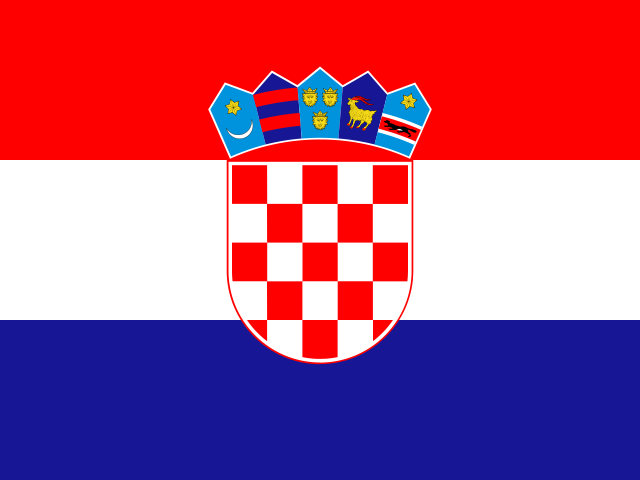 CRO
CRO
|
G | £1.8M |
| 2 |
JOSIP JURANOVIC
|
CRO
|
RB | £450k |
| 3 |
DOMAGOJ BRADARIC
|
CRO
|
LB | £800k |
| 4 |
IVAN PERISIC
|
CRO
|
LW | £1.8M |
| 5 |
DUJE CALETA-CAR
|
CRO
|
D | £2M |
| 6 |
DEJAN LOVREN
|
CRO
|
D | £1.8M |
| 7 |
 MARKO ROG MARKO ROG
|
CRO
|
RW | £1.8M |
| 8 |
MATEO KOVACIC
|
CRO
|
M | £3.5M |
| 9 |
ANDREJ KRAMARIC
|
CRO
|
A | £3M |
| 10 |
MARIO PASALIC
|
CRO
|
M | £1.9M |
| 11 |
NIKOLA VLASIC
|
CRO
|
M | £2M |
| 12 |
IVO GRBIC
|
CRO
|
G | £1.5M |
| 13 |
MARIN PONGRACIC
|
CRO
|
D | £1.6M |
| 14 |
LUKA MODRIC
|
CRO
|
M | £1.6M |
| 15 |
JOSIP BREKALO
|
CRO
|
LW | £1.8M |
| 16 |
BRUNO PETKOVIC
|
CRO
|
A | £1.6M |
LIVAKOVIC
JURANOVIC
CALETA-CAR
LOVREN
BRADARIC
CALETA-CAR
LOVREN
BRADARIC
ROG
KOVACIC
PASALIC
VLASIC
PERISIC
KOVACIC
PASALIC
VLASIC
PERISIC
KRAMARIC