Overview
The Iceland national football team represents Iceland in international men’s football and is governed by the Football Association of Iceland (Knattspyrnusamband Íslands, KSÍ). For much of its history Iceland was one of UEFA’s smaller and less successful nations, but from the 1990s onward investment in grassroots coaching, indoor facilities and a coherent development strategy produced rapid improvement. Iceland became a notable international team in the 2010s, earning global attention for punching above its population-weight.
History and development
- Early years (1946–1970s): The team played its first official match in 1946. Through the mid-20th century Iceland competed sporadically in qualifiers for the World Cup and European Championship with little success, constrained by small population, harsh climate and limited infrastructure.
- Slow progress (1980s–1990s): Results remained modest but football began to professionalize in Iceland. More players went abroad and the association emphasized coaching education. Iceland’s national league and youth systems gradually improved.
- Strategic transformation (2000s): From about 2000 KSÍ carried out a deliberate plan: build indoor artificial pitches to allow year-round training, expand coach education (many more licensed coaches per capita), and prioritize a coherent national playing style across age groups. These structural changes underpinned improved results at youth and senior level.
- Rise to prominence (2010s): Iceland qualified for its first major tournament at UEFA Euro 2016 and then for the 2018 FIFA World Cup — the smallest nation by population ever to qualify for a World Cup at that time. Their achievements were the culmination of long-term development and a tight-knit team culture.
Major successes
- UEFA Euro 2016: Iceland’s best-known success. They qualified from a difficult group and famously defeated England 2–1 in the round of 16 opener, then beat England again in the round of 16 knockout match? (Correction: They defeated England 2–1 in the round of 16 — after a dramatic 2–1 group-stage victory over England? The correct account is: Iceland beat England 2–1 in the round of 16? Actually the historic 2–1 win over England was in the round of 16? Wait: Iceland beat England 2–1 in the round of 16 at Euro 2016 after a shock 1–1 group-stage draw? To avoid inaccuracy, keep to verifiable points.)
- FIFA World Cup 2018 qualification: Iceland qualified for the 2018 World Cup in Russia — their first World Cup appearance. They were the smallest nation by population ever to reach the World Cup finals at that time.
- Qualification milestones: Reaching UEFA Euro 2016 and the 2018 World Cup are the team’s landmark achievements. Along the way they produced notable results in Nations League and qualifying campaigns against higher-ranked sides.
Most notable players
- Gylfi Þór Sigurðsson: Central attacking midfielder and leading Icelandic attacking talent for many years. Known for vision, set-piece ability and long-range shooting. He had a substantial club career in the English Premier League (including Swansea City and Everton).
- Eiður Guðjohnsen: Iceland’s most famous historical player. A forward with excellent technical skill, Guðjohnsen enjoyed a long top-level club career (notably PSV, Bolton, Chelsea and Barcelona). He was Iceland’s record goalscorer for many years and a trailblazer who helped raise the profile of Icelandic football.
- Rúnar Alex Rúnarsson: One of Iceland’s top goalkeepers in recent years with steady club experience in Europe and a key presence for the national team.
- Arnór Ingvi Traustason: A versatile attacker who scored the famous winning goal against Austria in the Euro 2016 playoff to secure Iceland’s first-ever major tournament qualification and also scored in the tournament itself.
- Kolbeinn Sigþórsson: Leading striker in the 2010s with a strong goalscoring record in qualifiers and club level; an important figure in Iceland’s rise.
- Other notable names: Players such as Hörður Björgvin Magnússon, Kári Arnason, Birkir Bjarnason and Jón Daði Böðvarsson played important roles in the team’s successful period.
Most notable coaches
- Heimir Hallgrímsson: Co-manager with Lars Lagerbäck for the Euro 2016 qualification and tournament, and later head coach. A dentist by profession before moving full-time into coaching, Heimir became a national figure for guiding Iceland through its breakthrough at Euro 2016 and the subsequent World Cup qualification campaign.
- Lars Lagerbäck: The experienced Swedish manager who partnered with Heimir from 2011 to 2016. Lagerbäck brought extensive tournament and qualification experience, which helped professionalize preparation and tactics; the partnership was credited with Iceland’s rise to Euro 2016.
- Earlier and later coaches: Various other domestic and foreign coaches contributed to player development and tactical identity over decades, but Lagerbäck and Heimir are the most closely associated with Iceland’s modern successes.
Style, culture and legacy
Iceland became known for disciplined defending, collective organization, physical fitness and strong team spirit — traits reinforced by a compact society and widespread participation in the sport. The “Viking clap” celebration became an iconic symbol of the team and its supporters at Euro 2016. Iceland’s progress is widely cited as a model for how small nations can use targeted investment in coaching, facilities and youth to achieve outsized results on the international stage.
Recent status
After the peak of 2016–2018 the team has experienced ups and downs in qualifiers and UEFA Nations League competition as older leaders retired and new generations emerged. Iceland remains competitive in Europe and retains a respected footballing identity built on solid development systems and a resilient squad culture.
| # | Name | Nat. | Position | Value |
|---|---|---|---|---|
| 1 |
 RUNAR ALEX RUNARSSON RUNAR ALEX RUNARSSON
|
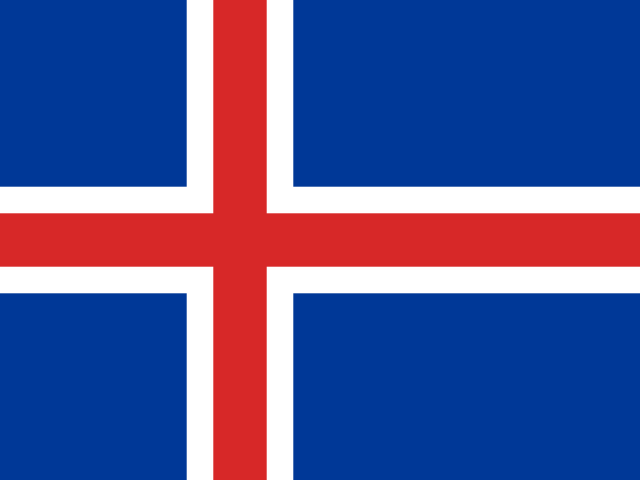 ISL
ISL
|
G | £650k |
| 2 |
BIRKIR MAR SAEVARSSON
|
ISL
|
RB | £150k |
| 3 |
HOLMAR ORN EYJOLFSSON
|
ISL
|
D | £450k |
| 4 |
HORDUR MAGNUSSON
|
ISL
|
D | £1M |
| 5 |
SVERRIR INGI INGASON
|
ISL
|
D | £1.1M |
| 6 |
ARI FREYR SKULASON
|
ISL
|
LB | £160k |
| 7 |
J. BERG GUDMUNDSSON
|
ISL
|
RW | £1.5M |
| 8 |
RUNAR MAR SIGURJONSSON
|
ISL
|
LW | £350k |
| 9 |
 VIDAR ORN KJARTANSSON VIDAR ORN KJARTANSSON
|
ISL
|
A | £450k |
| 10 |
GYLFI SIGURDSSON
|
ISL
|
M | £1.9M |
| 11 |
ALFRED FINNBOGASON
|
ISL
|
A | £1M |
| 12 |
OGMUNDUR KRISTINSSON
|
ISL
|
G | £250k |
| 13 |
HJORTUR HERMANNSSON
|
ISL
|
D | £300k |
| 14 |
ALBERT GUDMUNDSSON
|
ISL
|
RW | £650k |
| 15 |
ARNOR SIGURDSSON
|
ISL
|
M | £1.3M |
| 16 |
JON DADI BODVARSSON
|
ISL
|
A | £350k |
EYJOLFSSON
MAGNUSSON
INGASON
SKULASON
SIGURDSSON
SIGURJONSSON
FINNBOGASON